

Why the Answer is often both
By Patricia Whelan and Ethan Van Vorst, Associate Attorneys
Contributing research and writing by Arianna Aman, J.D. Candidate, Albany Law School
One of the most common questions estate planning attorneys hear is:
“Do I need a Will or a Trust?”
In most cases, the answer is both. While Wills and Trusts can work together to achieve similar goals, they serve distinct legal purposes.
The more important question is what an estate plan should accomplish. Estate planning is about more than distributing assets. It also helps protect loved ones, prepare for incapacity, preserve wealth, and ensure that a person’s wishes are carried out as intended. Because every situation is unique, understanding the role of each document is the first step toward creating a comprehensive estate plan.
A Will: The Foundation of Every Estate Plan
A Will is a legal document that explains how your probate assets should be distributed after your death and names the people responsible for carrying out your wishes. Probate assets generally include assets owned solely in an individual’s name that do not automatically transfer by operation of law or beneficiary designation upon death. These assets must pass through the court-supervised probate process before they can be distributed to beneficiaries.
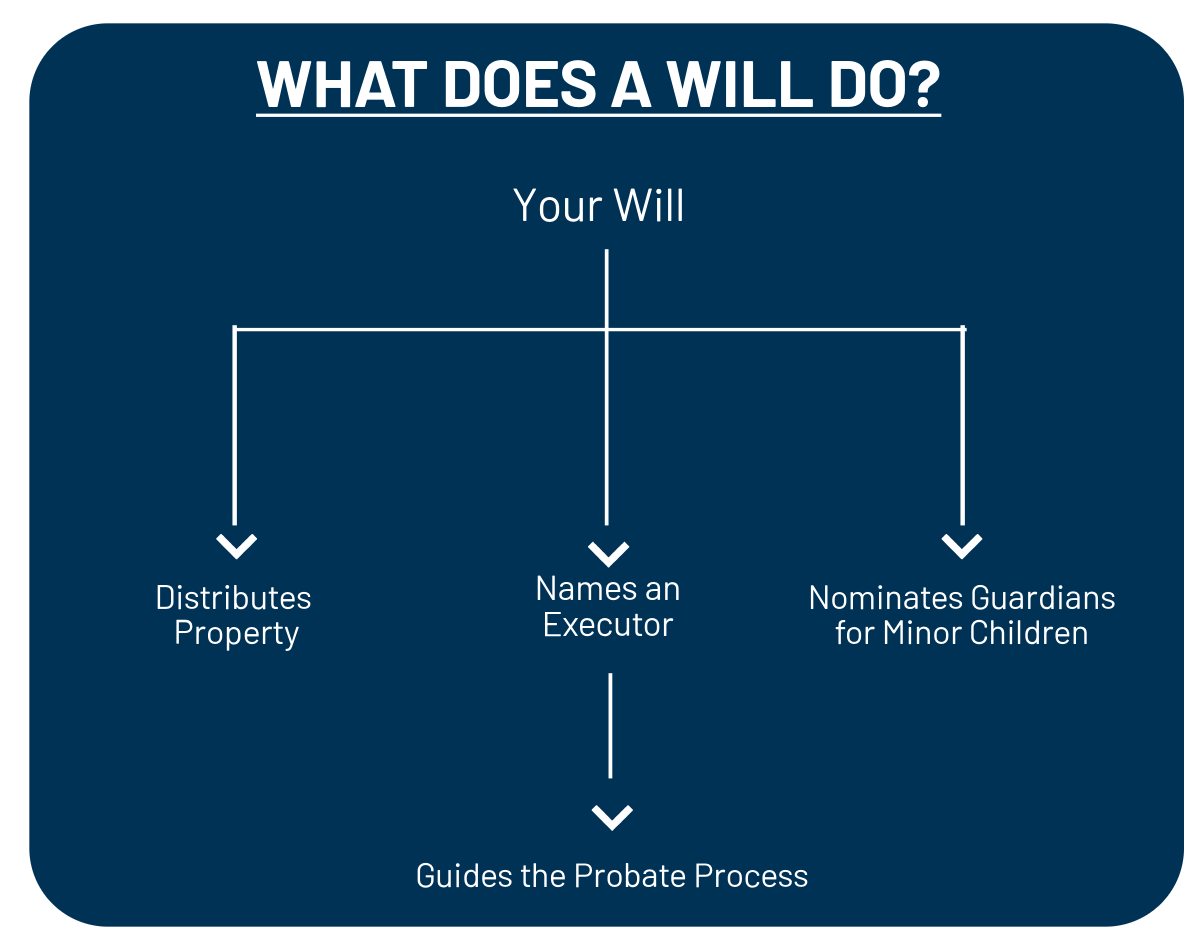
Through a Will, you choose who inherits your property and who will serve as your Executor: the person responsible for gathering assets, paying debts, expenses, and taxes, and distributing your estate according to your instructions.
For parents of minor children, a Will is especially important because it allows you to nominate a guardian. Although the court makes the final appointment, it generally gives significant weight to your choice unless that person is unfit. This nomination allows parents to identify the individual they believe is best suited to make decisions regarding a child’s care, education, healthcare, and overall well-being.
Without a valid Will, New York’s intestacy laws determine who inherits your probate assets. Those laws provide a default plan, but they rarely reflect every family’s needs and wishes.
For example, a married person with two children who wants everything to pass to a surviving spouse may be surprised to learn that, without a Will, New York law generally divides the estate between the spouse and children. Likewise, close friends, stepchildren, or charities generally receive nothing unless they are included in a valid estate plan.
The Benefits – and Limits – of a Will
A Will provides clear instructions after death, but it has important limitations.
A common misconception is that a Will avoids probate. It does not. In fact a Will holds no power until it is probated, and then it guides the probate process by telling the court how probate assets should be distributed. Probate is the court-supervised process of administering a deceased person’s estate, paying outstanding debts, and distributing probate assets to the appropriate beneficiaries or heirs.
A Will also has no legal effect during your lifetime. It cannot authorize someone to manage your finances if you become incapacitated, nor does it generally control assets that pass by beneficiary designation or joint ownership, such as retirement accounts or life insurance proceeds.
These limitations don’t make a Will less important; they simply show why additional planning documents are often needed.
A Trust: Planning Beyond Death
While a Will becomes operative at death, a Trust can provide protection during your lifetime, in the event of incapacity, and after death.
The person creating the Trust, called the Grantor, may transfers assets into the Trust during life or designate assets to pass to the Trust at death and establishes instructions for how those assets should be managed and distributed. The Trustee manages those assets according to the Trust’s terms.
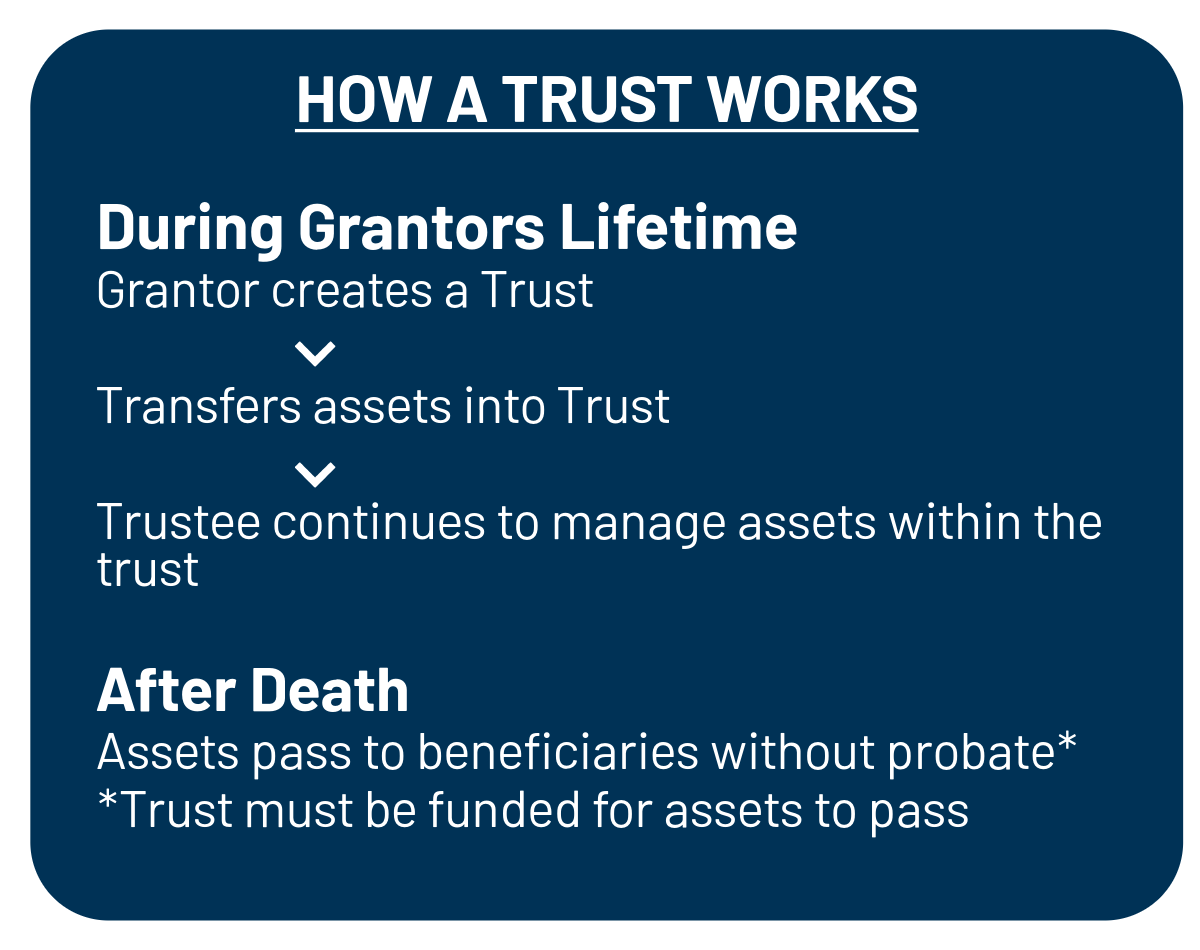
When a Trust is properly funded, its assets generally avoid probate, allowing them to pass more efficiently and with greater privacy than assets distributed through probate.
The most common type is a Revocable Living Trust (RLT), which allows assets to be managed during life, provides for incapacity, and avoids probate for trust assets. Other Trusts, such as Supplemental Needs Trusts (SNT) and Medicaid Asset Protection Trusts (MAPT), are designed for more specialized planning goals. Families with complex estates may also benefit from specialized Trust strategies.
Trusts provide flexibility that a Will cannot. Rather than distributing an inheritance all at once, a Trust can hold and manage assets over time according to your instructions. This can be especially valuable for those with young children, beneficiaries with disabilities, business owners, or families seeking long-term asset protection.
The right Trust depends on your family, financial situation, and long-term goals.
The Benefits – and Limitations – of a Trust
The advantages of a properly funded Trust include the ability to avoid probate for Trust assets, maintain privacy, provide continued asset management during incapacity, and establish ongoing management for beneficiaries following the grantors death.
But, like any legal instrument, a Trust is not a complete estate plan by itself.
A Trust is effective only to the extent it is properly funded. Creating the Trust agreement alone isn’t enough; assets generally have to be transferred into the Trust or otherwise made payable to the Trust to realize the intended benefits. Property that remains titled outside the Trust may still require probate. Because of this, many people who have a Trust also have provisions in their Will to “pour-over” their assets into their Trust after they have passed.
It is also important to understand that a Trust does not limit the need for other estate planning documents. Even individuals with a Trust should generally have a Will, power of attorney, healthcare directives, and other supporting documents. For these reasons, experienced estate planning attorneys frequently recommend multiple documents as part of a coordinated strategy.
What Are the Differences Between a Will and a Trusts?
Estate planning discussions often present Wills and Trusts as competing alternatives. But, in practice, they address different legal concerns.
Some of these key differences include:
Will |
Trust |
| Takes effect upon death | Takes effect once it is created and funded |
| Requires probate | Properly funded assets generally avoid probate |
| Becomes part of the public record during probate | Remains private |
| Does not provide for management of assets during incapacity | Provides for management of assets during incapacity |
| Primarily directs how assets are distributed after death | Manages and distribute assets during life, incapacity, and after death |
| Does not require assets to be transferred into it | Must be funded by transferring assets into the Trust |
| Distributes assets that are part of the probate estate, including those not specifically gifted elsewhere in the Will | Only assets titled in the Trust (or otherwise payable to it) are governed by the Trust; unfunded assets may still require probate |
| Nominates guardians for minor children | Cannot nominate guardians for minor children |
The distinction is not that one document is inherently superior to the other. Rather each fulfills legal functions the other cannot.
Beyond a Will: The Importance of Ancillary Estate Planning Documents

A complete estate plan includes more than just a Will or Trust.
A Durable Power of Attorney (DPOA) allows you to appoint someone to manage your financial and legal affairs if you become unable to do so. Without one, loved ones may need to commence a guardianship proceeding before someone can manage your financial affairs.
A Health Care Proxy (HCP) allows you to choose someone to make medical decisions if you cannot communicate your wishes.
Many estate plans also include a Disposition of Remains Appointment (DORA), which designates the person responsible for carrying out your burial, cremation, or other final disposition wishes.
Although these documents often receive less attention than a Will or Trust, they are essential parts of a comprehensive estate plan because they help reduce delays, expense, and unnecessary court involvement during difficult times.
Putting it All Together to Build a Complete Estate Plan
When it comes to the question “Do you need a Will or a Trust,” the answer is likely both. For many individuals and families, particularly those seeking to avoid probate or provide long term management of assets, a Trust may serve as a central component of the estate plan. As estates become more complex and families seek to minimize probate, preserve privacy, and provide long-term financial security for loved ones, a Trust often becomes the cornerstone of an effective estate plan.
A Will remains an essential part of every estate plan because it protects against intestacy (dying without a Will), nominates guardians for minor children, and addresses assets outside a Trust. A properly funded Trust, however, provides additional benefits by avoiding probate for Trust assets, planning for incapacity, maintaining privacy, and allowing greater control over how assets are managed and distributed.
The strongest estate plans rarely rely on a single document. For many individuals and families, a Trust serves as the foundation of that plan, while a Will provides essential protection that no Trust can replace. Together with other key estate planning documents, they create a coordinated strategy that helps protect loved ones, preserve assets, and ensure a person’s wishes are carried out both during life and after death.
The Value of Experienced Estate Planning Counsel
Estate planning is about much more than preparing legal documents. It involves understanding family dynamics, asset ownership, tax considerations, long-term care planning, and future goals.
Because every family is different, every estate plan should be tailored to the individual.
Whether creating an estate plan for the first time or reviewing documents prepared years ago, working with an experienced estate planning attorney helps ensure that every part of the plan works together to protect what matters most—today, tomorrow, and for future generations.
At Pierro, Connor, & Strauss, estate planning is approached as a collaborative legal process – not simply the preparation of documents. By carefully evaluating each client’s circumstances, assets, and objectives, the firm’s attorneys develop estate plans designed to protect families, preserve wealth, and simplify administration for future generations.
 https://www.pierrolaw.com/wp-content/uploads/2025/08/Graval-and-Law-books-4884-0669-7626-v1-scaled.jpg
1743
2560
Emily Smith
https://www.pierrolaw.com/wp-content/uploads/2021/01/pierrolaw-color-logo-transparent-300x132.png
Emily Smith2026-08-20 10:09:452026-08-20 11:11:09Pierro, Connor & Strauss Attorneys Honored by Best Lawyers®
https://www.pierrolaw.com/wp-content/uploads/2025/08/Graval-and-Law-books-4884-0669-7626-v1-scaled.jpg
1743
2560
Emily Smith
https://www.pierrolaw.com/wp-content/uploads/2021/01/pierrolaw-color-logo-transparent-300x132.png
Emily Smith2026-08-20 10:09:452026-08-20 11:11:09Pierro, Connor & Strauss Attorneys Honored by Best Lawyers® https://www.pierrolaw.com/wp-content/uploads/2026/04/iStock-951702110.jpg
1418
2115
Emily Smith
https://www.pierrolaw.com/wp-content/uploads/2021/01/pierrolaw-color-logo-transparent-300x132.png
Emily Smith2026-04-28 11:23:482026-04-28 11:56:43Pierro, Connor & Strauss Attorneys Named to 2026 Super Lawyers® and Rising Stars Lists
https://www.pierrolaw.com/wp-content/uploads/2026/04/iStock-951702110.jpg
1418
2115
Emily Smith
https://www.pierrolaw.com/wp-content/uploads/2021/01/pierrolaw-color-logo-transparent-300x132.png
Emily Smith2026-04-28 11:23:482026-04-28 11:56:43Pierro, Connor & Strauss Attorneys Named to 2026 Super Lawyers® and Rising Stars Lists https://www.pierrolaw.com/wp-content/uploads/2026/03/iStock-2220541897-e1773848448124.jpg
735
2120
Emily Smith
https://www.pierrolaw.com/wp-content/uploads/2021/01/pierrolaw-color-logo-transparent-300x132.png
Emily Smith2026-03-18 12:31:252026-03-18 15:35:14How to Use a Trust in Medicaid Planning
https://www.pierrolaw.com/wp-content/uploads/2026/03/iStock-2220541897-e1773848448124.jpg
735
2120
Emily Smith
https://www.pierrolaw.com/wp-content/uploads/2021/01/pierrolaw-color-logo-transparent-300x132.png
Emily Smith2026-03-18 12:31:252026-03-18 15:35:14How to Use a Trust in Medicaid PlanningClick here to add your own text
